This post adds detail to our history of Satta King and Matka. It is about two men, कल्याणजी भगत (Kalyanji Bhagat) and रतन खत्री (Ratan Khatri), and what news archives actually record about them. Much of their story rests on oral history retold by journalists, so we mark what is well sourced, what is reported by one source only, and where sources disagree. In news reports, a "King" such as "Matka King" or "Satta King" usually means the operator who ran a racket, not a person who gained from it.
Before matka: bets on cotton figures
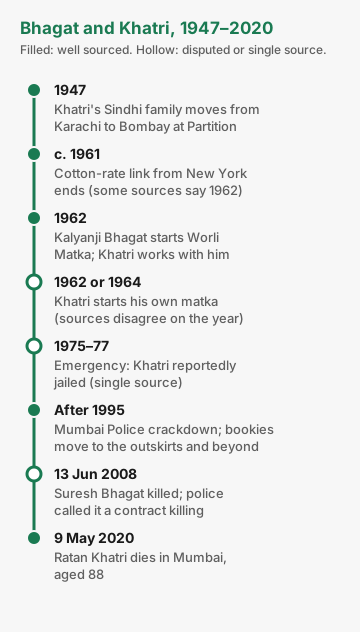
Before the 1960s, people in Bombay bet on the opening and closing rates of cotton, which came by teleprinter from the New York Cotton Exchange to the Bombay Cotton Exchange. The Free Press Journal's PTI obituary of Khatri, DNA (2013) and Business Today (2021) all describe this. According to DNA and Business Today, the New York exchange "halted the practice" in 1961; some pages say 1962. No exchange archive confirming the story has been found, so treat the details as press history rather than documented fact.
Kalyanji Bhagat and Worli Matka
Kalyanji Bhagat is described as a Kutchi trader who ran a grocery shop in Worli and took bets on cotton figures. He is credited with starting Worli Matka in 1962. PTI dates the start of matka itself to 1962, and the Wikipedia article on matka gives the same year. Wikipedia also says his matka ran seven days a week; that detail has one source only.
Two claims about him are common online but unproven. Many pages say the name "Kalyan" in later matka games comes from Kalyanji Bhagat; we found no reliable source for that. His date of death is also not reliably recorded.
Ratan Khatri: Partition, then Bombay
Ratan Khatri was born around 1932 into a Sindhi family from Karachi and came to Bombay as a teenager at Partition in 1947 (PTI; Zee News). He worked with Kalyanji Bhagat when Worli Matka started and then broke away to run his own game, known as Ratan Matka and, according to Wikipedia, also as "Main Bazaar".
When the cotton figures stopped, Khatri reportedly proposed declaring "rates" for imaginary products instead. According to DNA, Business Today and Wikipedia, numbers were written on slips, placed in a matka (an earthen pot) and drawn out; later the draw moved to cards, but the name "matka" stayed. PTI says he "earned the sobriquet of 'Matka King'".
Two founding dates
Sources disagree on when Khatri's own matka began. Wikipedia's article on matka gambling gives 1964, calling it the "New Worli matka", run Monday to Friday. Its article on Khatri gives 1962. The safe statement is that he started it in the early 1960s, with sources giving 1962 or 1964.
The crackdown years
Matka spread among Bombay's textile mill workers, with bookies near the mills in Central Mumbai (Parel) and Kalbadevi (DNA; Wikipedia). Estimates of the trade at its 1980s–90s peak differ tenfold: DNA reported "over Rs500 crore" bet each month, while Business Today gives about ₹50 crore. Neither figure can be checked.
- The Emergency (1975–77). Khatri was reportedly jailed for 19 months. This comes from Wikipedia and entertainment profiles; the PTI and Zee obituaries do not mention it.
- The 1990s. Zee News says he ran the business until the 1990s, "when Mumbai Police cracked down on his illegal businesses". Wikipedia says he retired in 1993.
- After 1995. DNA wrote that "the crackdown by the police after 1995 dealt a serious blow to the business", and that the number of big and medium bookies fell from more than 2,000 to fewer than 300 by 2013. Operations reportedly moved to the city's outskirts and to Gujarat and Rajasthan.
How the story ended
Ratan Khatri died on Saturday 9 May 2020 at Navjeevan Society in Mumbai Central, aged 88, according to PTI. Zee News gave 10 May; Business Today and Wikipedia agree with 9 May.
The Bhagat family story ended more violently. Kalyanji Bhagat's son, Suresh Bhagat, also described in the press as a "matka king", died on 13 June 2008 in what first looked like a road accident near Alibaug. Police later said it was a contract killing linked to control of the Kalyan matka business (OneIndia, 18 Jun 2008). That account comes from one news report we could read directly.
Neither life is a success story. Both men's names are tied to an illegal trade, police action and, in the Bhagat family's case, a killing.
Where the sources disagree
| Detail | Versions | How we treat it |
|---|---|---|
| End of the cotton link | 1961 (DNA, Business Today) or 1962 (other pages) | "Around 1961" |
| Khatri's own matka | 1962 (Wikipedia, Khatri) or 1964 (Wikipedia, Matka gambling) | "Early 1960s" |
| Peak monthly turnover | ₹50 crore (Business Today) or over ₹500 crore (DNA) | Range, with both sources named |
| Jail during the Emergency | 19 months (Wikipedia); not in PTI or Zee | "Reportedly" |
| Khatri's retirement | "Until the 1990s" (Zee) or 1993 (Wikipedia) | "The 1990s" |
| Khatri's death | 9 May 2020 (PTI, Business Today) or 10 May (Zee) | 9 May 2020 |
| "Kalyan" named after Bhagat | Widely assumed; no reliable source | Not stated as fact |
Khatri's story has also been told on screen. The 1975 film Dharmatma reportedly modelled a character on him, and the 2026 series Matka King is widely described as inspired by both men; our fact check of the series compares it with this record. For how Bombay matka differs from the North Indian games on this site, read Satta Matka vs Satta King.