This explainer sits under our main guide, Is Satta King legal in India?. It covers the national law on online money games, known in Hindi as the ऑनलाइन गेमिंग कानून 2025. Satta itself is still mainly a matter for state gambling laws, which the main guide explains.
The Act in one paragraph
The Promotion and Regulation of Online Gaming Act, 2025 (Act No. 32 of 2025) bans every "online money game", whether it is based on skill, chance or both. Three things are prohibited: offering such games (section 5), advertising them (section 6) and handling payments for them (section 7). The Act sets up the Online Gaming Authority of India, lets the Centre block information linked to these services, and gives authorised officers wide search powers. It applies to services offered in India and to services "operated from outside the territory of India" (section 1(2)). It contains no offence for simply using such a game.
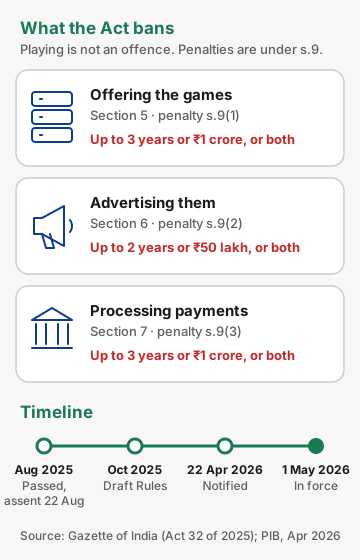
Timeline
| Date | Step |
|---|---|
| 20 Aug 2025 | Introduced and passed in the Lok Sabha (Bill No. 110 of 2025) |
| 21 Aug 2025 | Passed by the Rajya Sabha |
| 22 Aug 2025 | Presidential assent; published as Act No. 32 of 2025 |
| 1–2 Oct 2025 | MeitY released the draft Rules for comment (comments were due by 31 Oct 2025) |
| Jan 2026 | Trade press reported that the Act was still not notified |
| 22 Apr 2026 | Notifications issued: commencement, the Online Gaming Authority of India, authorised investigating officers, and the Promotion and Regulation of Online Gaming Rules, 2026 |
| 1 May 2026 | Act and Rules in force |
Some early reports gave 1 October 2025 as the start date. That was an announced target, not the commencement date. Section 1(3) left the date to a government notification, and the notifications of 22 April 2026 fixed it at 1 May 2026.
When the Bill was passed, reports quoted a government estimate that about 45 crore people were affected and about ₹20,000 crore was lost each year. That figure comes from a newspaper report (The Hitavada), not from the Act.
Key definitions
- Online game: "any game, which is played on an electronic or a digital device and is managed and operated as a software through the internet or any other kind of technology facilitating electronic communication" (s.2(1)(f)).
- Online money game: an online game, "irrespective of whether such game is based on skill, chance, or both", where the user pays fees or deposits "money or other stakes in expectation of winning" something of money's worth in return. E-sports are excluded (s.2(1)(g)).
- Other stakes: anything "recognised as equivalent or convertible to money", including credits, coins, tokens or objects, "whether it is real or virtual" (s.2(1)(j)).
- Advertisement: has the meaning given in the Consumer Protection Act, 2019. That covers "any audio or visual publicity, representation, endorsement or pronouncement" made by print, electronic media, "internet or website" (s.2(1)(a)).
The skill-or-chance question, which decided many older court cases, no longer matters here. If money or money's worth is staked in the hope of a return, the game is an online money game.
What is banned (sections 5 to 7)
- Section 5, offering: "No person shall offer, aid, abet, induce or otherwise indulge or engage in the offering of online money game and online money gaming service."
- Section 6, advertising: no one may make or be involved in "any advertisement, in any media including electronic means of communication, which directly or indirectly promotes or induces any person to play any online money game or indulge in any activity promoting online money gaming".
- Section 7, payments: no bank, financial institution or other person handling payments may "facilitate any transaction or authorisation of funds towards payment for any online money gaming service".
Penalties and which offences are cognizable
| Who is punished | First offence | Repeat offence |
|---|---|---|
| Whoever offers an online money gaming service (s.9(1)) | Up to 3 years, or fine up to ₹1 crore, or both | 3–5 years and ₹1–2 crore (s.9(4)) |
| Whoever makes or causes to make an advertisement (s.9(2)) | Up to 2 years, or fine up to ₹50 lakh, or both | 2–3 years and ₹50 lakh–1 crore (s.9(5)) |
| Whoever facilitates the payments (s.9(3)) | Up to 3 years, or fine up to ₹1 crore, or both | 3–5 years and ₹1–2 crore (s.9(4)) |
Section 9 punishes the person who offers the service or who makes or causes the advertisement. The "aid" and "abet" words in sections 5 and 6 are not given their own penalty in section 9, although the general abetment law, blocking and official directions can still reach such people.
Under section 10, the offences linked to sections 5 and 7 (offering and payments) are cognizable and non-bailable. The advertising offence is not on that list. Under section 11, officers in charge of a company can be liable unless they show they did not know or took due care. Section 12 adds a civil penalty of up to ₹10 lakh for breaking directions issued under section 8(3), along with suspension or cancellation of registration.
Blocking, search and seizure (sections 14 to 16)
- Blocking (s.14): if sections 5, 6 or 7 are breached, "any information generated, transmitted, received or hosted in any computer resource in relation to online money gaming service" can be blocked using the procedure in section 69A of the IT Act. Our post on how India blocks betting sites covers this in detail.
- Investigators (s.15): the 22 April 2026 notification lets State and UT cyber-cell and nodal police officers investigate, including at police-station, district and Commissionerate level.
- Search and arrest (s.16): authorised officers may enter "any place, whether physical or digital", including a computer resource, and may search and arrest without a warrant a person "reasonably suspected" of an offence.
- Overriding effect (s.18): the Act applies in addition to other laws and overrides any law that conflicts with it.
The Online Gaming Authority of India
The Online Gaming Authority of India (OGAI) is an attached office of the Ministry of Electronics and IT (MeitY) in Delhi, run as a "digital office". It is chaired by an Additional Secretary of MeitY. Its members are Joint Secretary-level officers from the ministries of Home Affairs, Finance, Information and Broadcasting, Youth Affairs and Sports, and Law and Justice.
- It "maintains and publishes the list of online money games", issues directions and codes of practice, and works with banks and law enforcement.
- It decides whether a particular game is an online money game, on its own motion or on application, ideally within 90 days. It looks at entry fees or deposits, bets or wagers, the expectation of a money reward, the revenue model and whether in-game items can be turned into money. Each decision applies to one game and one provider.
- A user can appeal to the Authority within 30 days, and the Authority aims to decide within 30 days. A further appeal goes to the Secretary, MeitY. Penalty cases are meant to finish within 90 days of the complaint.
- Its remit includes guidelines on "advertisements relating to online games".
What the Act does not do
- It does not punish users. Chapter V creates offences only for offering, advertising and payments.
- It does not cover e-sports as online money games; they are excluded by the definition.
- It does not cover games with no stakes. A game becomes an online money game only when money or "other stakes" are paid in expectation of a return.
- It does not replace state gambling laws. Betting and gambling remain a state subject, and state laws continue to apply.
Legal challenge status
Gaming companies have challenged the Act. The challenges are pending before the Supreme Court. No stay or interim relief has been granted (as of 25 October 2026). On 5 August 2026 the court agreed to a final hearing. Our Supreme Court case tracker lists every hearing. A separate Supreme Court ruling on GST, which looked at stakes rather than skill, is covered in our post on the 2026 GST judgment.
What it means for satta
Satta run through an app or website, where users deposit money, fits the definition of an online money game when it is "managed and operated as a software through the internet". Satta booked offline in cash is mainly a matter for state law. In March 2026 the government said a new round of blocking had "also been taken against satta and matka gambling networks".
Separately, anyone selling so-called "leak" or "fix" numbers is running a scam, whatever the law says about the game itself. Our guide to leak and fix number scams explains how they work. For the overall legal picture, including state laws and BNS section 112, read Is Satta King legal in India?.