This post sits under our guide to satta scams. Unlike most of the scams we cover, this one targets people who have never placed a bet. A message offers easy money for the use of your bank account, sometimes called बैंक खाता किराये पर देना (renting out your account). It is one of the main ways illegal betting money is moved, and the person who loses most is often the account holder.
What a mule account is
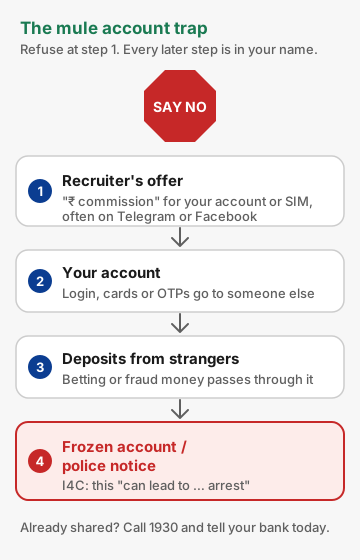
A "mule" account, or म्यूल अकाउंट, is a real bank account that is used by someone other than its owner to receive and pass on money. The owner is paid once or every month and hands over the login details, debit card, cheque book or the SIM linked to the account. Strangers' deposits then flow in and out. Because the account belongs to you, the transactions point to you, not to the people who used it.
In an alert on 28 October 2024, the Indian Cyber Crime Coordination Centre (I4C) of the Ministry of Home Affairs said current and savings accounts are being "scouted through social media; majorly from Telegram and Facebook". It said they are controlled remotely from overseas and used to accept deposits for "offshore betting and gambling websites".
How betting networks recruit
- Social media and chat apps. Telegram and Facebook posts offer "part-time work", "commission" or "account verification" jobs (I4C, 2024).
- A fee for documents. In Sagar, Madhya Pradesh, police said a gang paid unemployed people commission for their documents and opened more than 30 fake firms with current accounts (ETV Bharat, Aug 2026).
- Commission on volume. A Gujarat probe described a commission-based structure for supplying accounts (IANS, Jun 2026).
- Pyramid recruiting. A May 2025 CUTS International study, reported by MediaNama, found that UPI was the main deposit channel for illegal gambling and that mules were recruited in a pyramid structure through Telegram groups.
The offer is usually made to sound harmless: the account is needed only for a short time, or you keep a small cut of what passes through. Nobody pays a stranger for a bank account unless they need to hide whose money is in it.
Real cases
| Date | Where | What was reported |
|---|---|---|
| 5 Jun 2025 | West Bengal, Delhi, Bihar, UP, Assam (ED Kolkata) | The ED froze 766 mule bank accounts and 17 cards and arrested two people. Recruits were paid a one-time or monthly fee to open accounts they had no control over. |
| 21 Jun 2026 | Gujarat | A cricket-betting probe found 281 bank accounts in one accused person's WhatsApp data (50 frozen) and 1,907 account details on another device (304 frozen). |
| 20 Aug 2026 | Sagar, Madhya Pradesh | Police said about ₹90 lakh moved through one account alone. They seized ₹2.69 crore in cash and about ₹30 lakh in gold, and arrested six people. |
These figures are as reported by the ED, police and news agencies; the cases had not been tried when reported. At national level, I4C's Suspect Registry, launched with banks on 10 September 2024, had shared 32.08 lakh "Layer 1 mule accounts" by 30 June 2026 (PIB, 22 Jul 2026).
The legal risk to the account holder
I4C's advice is direct: people should not sell or rent their bank accounts, because "illicit funds deposited in such bank accounts can lead to legal consequences, including arrest." In practice, account holders face:
- A frozen account. Banks and police freeze accounts that receive reported fraud or betting money, often with your own savings still in them.
- A police notice or case. The account is in your name and your KYC documents opened it, so investigators start with you.
- Gambling and organised-crime laws. Online money games, and payments for them, are banned under the Online Gaming Act 2025. Under section 112 of the Bharatiya Nyaya Sanhita, unauthorised betting or gambling committed by a member of a group or gang is "petty organised crime", punishable with 1 to 7 years and a fine.
- Your name on a bank list. Accounts shared through the Suspect Registry can be refused transactions across banks.
Whether a particular person is charged depends on the facts. We cannot give legal advice; if you are worried, speak to a lawyer.
What to do if you already shared your account
- Stop at once. Do not take any more money and do not reply to the recruiter.
- Go to your bank. Ask them to block your debit card, net banking and UPI, issue new credentials, and record that someone else has been using the account.
- Get your SIM back or ask your mobile operator to block it and issue a new one.
- Report it. Call 1930 or file at cybercrime.gov.in. Keep screenshots of the offer, chats and any payments you received.
- Speak to a lawyer if you receive a police notice. Do not ignore it.
If someone asks you to install an app as part of the deal, read our post on fake satta apps and APKs. If money worries or gambling are weighing on you, the free helplines can help.